Buying a car is exciting—but for many, the biggest barrier isn’t choosing the model or color—it’s paying the down payment. That’s where the buzz around Zero Down Payment Car Loans comes in. Ads dazzle you with headlines like:
- “Drive home without paying a rupee upfront!”
- “0% down — zero hassles!”
- “Own your dream car without breaking the bank!”
It sounds liberating: Get a car today without dipping into your savings. But is it really that simple?
Is zero down truly “free,” or are you stepping into a financial trap that costs you more later?
This comprehensive guide reveals:
✔ What zero down payment car loans actually are
✔ How they work behind the scenes
✔ The truth lenders often don’t highlight
✔ Hidden costs you must know before signing
✔ Pros and cons from a financial perspective
✔ Real examples with numbers
✔ Smart strategies to handle car finance
✔ Mistakes to avoid at all costs
By the end of this article, you’ll be able to decide for yourself:
👉 Is a zero down payment car loan a smart financial tool — or a danger disguised as convenience?
1. What Is a Zero Down Payment Car Loan? (Crystal Clear Explanation)
A zero down payment car loan is a financing option where:
- The lender pays the entire price of the car.
- You don’t make any upfront payment (down payment).
- You start repaying the loan through EMIs (Equated Monthly Installments) over the agreed tenure.
In contrast, a traditional car loan usually requires you to pay a certain percentage of the car’s price upfront (typically 10–25%) before the lender releases the remaining amount.
Zero down = 100% financing of the car.
But there’s a catch—100% financing doesn’t mean zero payment. It just means you defer payment from upfront to monthly installments + interest + fees.
2. How Do Zero Down Payment Car Loans Work? (The Money Flow)
Here’s the step-by-step flow:
- Car Selection
You pick a car (new or used) at a dealership. - Loan Application
You apply for a car loan with zero down payment. - Loan Assessment
The lender reviews:- Credit score
- Income stability
- Existing EMIs / obligations
- Vehicle type (new/used)
- Borrower profile
- Loan Approval
If eligible, the lender sanctions a loan for 100% of the on-road car price. - Disbursement
The car loan amount is paid directly to the dealer/seller. - EMI Payments Start
You start paying EMIs for the total loan, including the part you didn’t pay upfront. - Loan Completion
Once you finish EMIs, the car belongs fully to you.
3. Why Do Lenders Offer Zero Down Payment Options? (Their Side of the Story)
You might wonder, “Why would a lender offer a zero down car loan if it’s such a risk?”
Here’s the honest truth:
1. They Earn More Interest
If you borrow more (100% of the car price), the interest paid over time increases.
Example:
- Car price: ₹10 lakh
- Loan with 20% down → loan = ₹8 lakh
- Loan with zero down → loan = ₹10 lakh
More loan → more interest → more profit for the lender.
2. Higher Processing Fees
Car loan processing charges are usually a percentage of the loan amount. A bigger loan means higher fees.
3. Dealer Partnerships
Many dealerships work with specific banks/fintech providers to push zero down offers to boost sales.
4. Competitive Advantage
Advertisement appeal: “No upfront cost” grabs attention and drives footfall to showrooms.
So lenders don’t do this out of generosity—they do it for better returns.
If you want to create AI Ads you can visit: https://adscribe.online
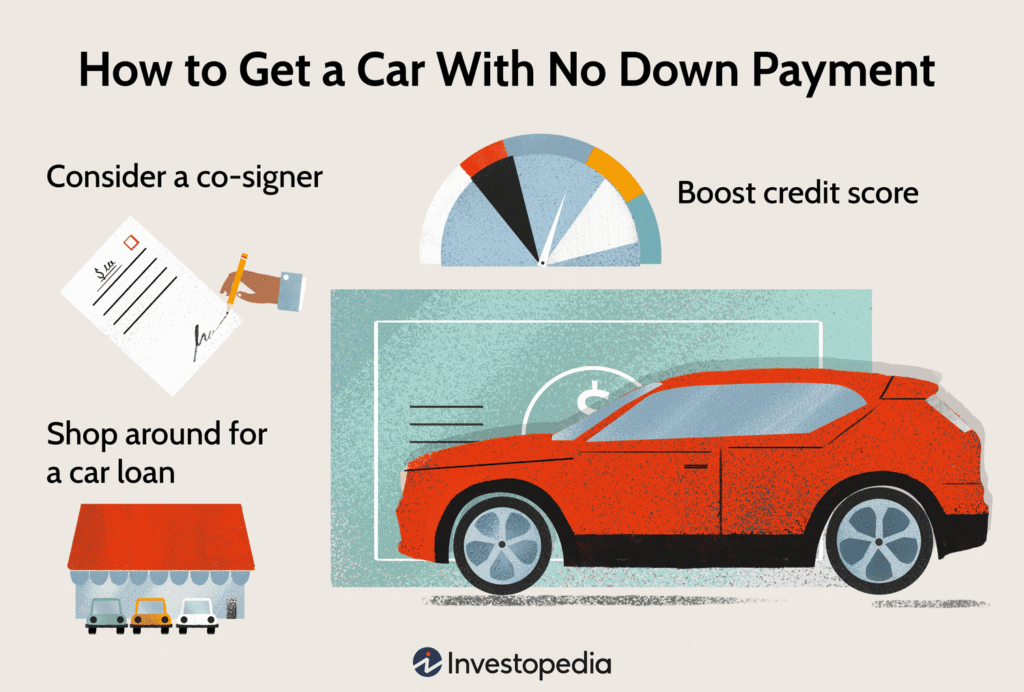
4. Zero Down Payment—Not Always 100% Down Payment Waived
This is one of the most misunderstood aspects.
Even if the car loan covers 100% of the ex-showroom price, there may still be parts you must pay upfront, such as:
✔ Registration fees
✔ Insurance premium
✔ Road tax
✔ Extended warranty packages (if mandatory for zero down)
✔ Pre-delivery inspection charges
In some deals, the lender finances the car price but not the add-ons. So calling it “zero down” can be misleading if you’re unaware of these items.
5. The Real Cost of Zero Down Payment Car Loans
Let’s break down the true cost you should calculate—not just the EMI.
✔ Loan Amount
This is the full principal you borrow.
✔ Interest Payable
Total interest across the loan tenure adds up based on the principal and interest rate.
✔ Processing Fee
Often 0.5 – 2% of the loan amount.
✔ Down Payment (Myth)
In zero down deals, this is skipped—but you may still pay other upfront costs.
✔ Insurance & Taxes
These are usually paid upfront (sometimes financed separately).
✔ Prepayment / Foreclosure Charges
Some lenders charge a fee if you repay early.
✔ Hidden Charges
Documentation fees, administrative costs, GST on fees, loan conversion fees, etc.
Always check the breakdown carefully.
6. Pros of Zero Down Payment Car Loans (What You Actually Get)
Despite the pitfalls, zero down car loans have real benefits—when used correctly.
1. Immediate Car Ownership Without Big Savings
For people who don’t have enough liquid cash, this option lets you buy a car without waiting to save up.
2. Better Cash Flow
No large upfront cash outflow means more money stays in your bank for emergencies or other needs.
3. Quick Access
You don’t delay buying the car; you drive it home immediately.
4. Financial Flexibility
Spreads cost over time — good for people with irregular income.
5. Competitive Deals
With strong credit, you may get competitive interest rates even with zero down.
7. Cons of Zero Down Payment Car Loans (The Hidden Reality)
1. Higher Interest Over Time
Because the loan principal is larger, total interest paid is significantly higher.
This alone can add lakhs of rupees over time compared to a traditional loan with a down payment.
2. Higher EMIs
Borrowing a larger amount means your monthly EMIs will be higher compared to if you had paid a down payment.
3. Negative Equity Risk
Your loan amount could be higher than the car’s actual market value, especially early in the loan term. If the car’s value drops (as vehicles always do), you may owe more than the car is worth.
4. Pressure on Future Finances
Higher EMIs reduce your disposable cash, making you vulnerable if income drops suddenly.
5. Hidden Fees Can Add Up
Processing fees, documentation charges, insurance add-ons—these can surprise you if you don’t read the fine print.
8. Real Example: Zero Down vs Traditional Down Payment Car Loan
Let’s compare two scenarios with numbers (hypothetical, illustrative):
Scenario A — Traditional Loan
Car price: ₹10 lakh
Down payment: 20% (₹2 lakh)
Loan amount: ₹8 lakh
Interest rate: 10%
Tenure: 5 years
EMI: ~₹17,000
Total interest: ~₹2.0 lakh
Total paid: ₹10 lakh (₹8 loan+₹2 down) + ₹2.0 lakh interest = ₹12.0 lakh
Scenario B — Zero Down Payment Loan
Car price: ₹10 lakh
Down payment: ₹0
Loan amount: ₹10 lakh
Interest rate: 10%
Tenure: 5 years
EMI: ~₹21,300
Total interest: ~₹2.6 lakh
Total paid: ₹10 lakh + ₹2.6 lakh interest = ₹12.6 lakh
Even without factoring hidden fees, the zero down option cost ₹60,000 more in interest alone over 5 years.
Add processing fees, insurance upcharges, and potential conversion fees and the gap may widen further.
9. The Hidden Charges Nobody Tells You (Read Carefully!)
Many people grab zero down offers but miss these invisible costs:
1. Loan Processing Fee
Usually a % of loan amount — often non-refundable.
2. Documentation Charges
Paperwork costs may be billed separately.
3. Insurance Premium Add-Ons
Dealers often bundle expensive insurance with zero down deals.
4. Prepayment / Foreclosure Charges
If you repay early, charges can be significant—especially with fixed-rate loans.
5. Conversion Charges
If you switch from fixed to floating rate or vice versa, fees may apply.
6. GST on Fees
In India, GST is charged on processing fees, documentation, etc.—often overlooked.
7. Loan Renewal / Rollover Fees
If you extend the loan or restructure, costs may apply.
8. Extended Warranty or Service Packages
Dealers may push high-margin packages when you choose zero down.
These costs don’t show in EMI alone—but they affect your overall car finance cost.
10. Is Zero Down Payment Right for Everyone? (The Truth)
No. Not everyone should take a zero down car loan. It’s best suited only in specific circumstances:
Good Candidates For Zero Down
✔ Strong credit score and income stability
✔ High trust in future income growth
✔ Need the car immediately (urgent requirement)
✔ Strong budgeting discipline
✔ Ability to pay higher EMIs comfortably
✔ Think long-term and plan to prepay early
Bad Candidates For Zero Down
✘ Irregular or unstable income
✘ Poor or average credit score
✘ Tight monthly budget
✘ Planning to sell car early
✘ Not financially disciplined
✘ First time borrowing, no experience with loans
For these people, traditional loans with down payment are usually safer and cheaper.
11. Common Misconceptions About Zero Down Loans
❌ “Zero down means no cost.”
Wrong. It means no upfront down payment — NOT no cost.
❌ “Banks lose money on zero down offers.”
Wrong. They earn more interest and fees.
❌ “Zero down is always the best deal.”
Wrong. It depends on your income, budget, and financial goals.
❌ “Insurance is included.”
Sometimes it is bundled — but often at a higher premium.
12. How to Compare Zero Down Offers Like a Pro
Before you choose any car loan, especially zero down, follow this comparison checklist:
Step 1: Check Interest Rate
Even a 0.5% difference alters total cost significantly.
Step 2: Check Processing Fees
Lenders differ widely on processing charges.
Step 3: Ask for Full Cost Breakdown
Demand a written schedule of charges: fees, penalties, prepayment, foreclosure.
Step 4: Compare Total Repayment Amount
Look beyond EMI. Compare total money paid over tenure.
Step 5: Consider Resale Value
Cars lose value; a higher loan amplifies negative equity.
Step 6: Factor Insurance Costs
Factor in OEM and third-party insurance.
Step 7: Run EMI and Cost Calculators
Use online tools to estimate accurate figures.
13. Hidden Risk #1: Negative Equity (Also Called Being “Underwater”)
Negative equity means:
You owe more on the loan than the car is worth.
This happens most often in:
✔ Zero down loans
✔ Long tenures
✔ Fast new car depreciation
If you sell the car early (within 1–3 years), negative equity can trap you financially.
14. How Zero Down Affects Your Credit Score and Future Loans
Initially, zero down loans don’t affect credit score negatively if:
✔ EMIs are paid on time
✔ No defaults occur
BUT having a larger loan balance for longer can:
✔ Increase your credit utilization
✔ Reduce eligibility for future loans
✔ Increase risk profile with lenders
So discipline and planning are essential.
15. Smart Alternatives to Zero Down Payment
If paying a large down payment upfront is tough, here are smarter alternatives:
1. Split Down Payment Savings
Instead of waiting forever, save a smaller amount first and combine with trade-ins.
2. Use Liquid Investments Carefully
Use fixed deposits or mutual funds partially if interest earned is lower than loan interest.
3. Negotiate with Dealer
Sometimes dealers offer better pricing or incentives if you negotiate.
4. Shorten Loan Tenure
Rather than zero down, choose a slightly shorter tenure with a smaller down payment.
5. Consider Certified Pre-Owned & Lower Price Cars
Lower car price reduces loan size and interest burden.
16. Real Life Examples — Zero Down vs Smart Down Payment
Let’s compare two buyers to highlight the real cost difference.
Buyer A — Zero Down
Car price: ₹10 lakh
Loan: ₹10 lakh
Interest: 10%
Tenure: 5 years
EMI: ~₹21,300
Total interest: ~₹2.6 lakh
Total paid: ₹12.6 lakh
Buyer B — Partial Down Payment (20%)
Car price: ₹10 lakh
Down payment: ₹2 lakh
Loan: ₹8 lakh
Interest: 10%
Tenure: 5 years
EMI: ~₹17,000
Total interest: ~₹2.1 lakh
Total paid: ₹10 + ₹2 down = ₹12.1 lakh
Even with the same interest rate and tenure, Buyer B saves around ₹50,000+ on interest alone.
That’s the real financial power of even a moderate down payment.
You can also read our other loan related blogs, please visit: https://loans.fundicainvestments.com/floating-vs-fixed-rate-for-home-loans/
17. Frequently Asked Questions (FAQ)
1. Is a zero down payment car loan bad?
No — not always. But it’s riskier and costlier in interest. If you can afford higher EMIs and plan well, it can be used strategically.
2. Are there lenders who always offer zero down?
Not always. Offers are often promotional or linked with specific car models or dealer tie-ups.
3. Can I prepay a zero down loan?
Yes — but check prepayment penalties first.
4. Does zero down loan affect credit score?
Not inherently. But higher loan balances and late payments do.
5. Should I always avoid zero down?
Not necessarily. If you truly need the car immediately AND you can manage payments responsibly, zero down can be used — with caution.
18. Mistakes Buyers Make With Zero Down Payment Loans
Avoid these traps:
❌ Believing “no down payment = no cost”
❌ Not comparing total cost across lenders
❌ Ignoring hidden fees
❌ Taking longest loan tenure just to reduce EMI
❌ Buying more car than you need due to “easy” financing
❌ Relying on dealer promises without written details
Each of these can cost you thousands of rupees.
19. How to Negotiate Better Car Loan Deals (Including Zero Down)
Don’t give lenders control of the narrative. Here’s how to negotiate:
✔ Check multiple lenders before buying
✔ Ask for lower interest based on credit score
✔ Negotiate processing fee
✔ Ask for free accessories or upsell items
✔ Request offer validity in writing
✔ Compare online vs offline loan rates
Negotiation can save way more than skipping a down payment.
20. Conclusion: Zero Down Payment Car Loans — Use Them Smartly, Not Blindly
Zero down payment car loan sounds tempting—especially when you don’t have ready cash. But if you focus only on “no upfront cost” without understanding real cost implications, you end up paying more over time.
Here’s the honest conclusion:
✅ Zero Down Loans Are Helpful When:
✔ You urgently need a car
✔ Your income is stable and rising
✔ You can manage higher EMIs
✔ You plan smart financial planning
✔ You understand total costs
🚫 Zero Down Loans Are Risky When:
✘ You struggle with monthly budget
✘ Your credit score is average
✘ You plan to sell the car soon
✘ You ignore hidden fees
✘ You don’t read the fine print
Zero down payment car loans are neither inherently good nor bad — they are simply a financial tool. When used wisely, they can serve a purpose. But when used blindly, they become expensive traps.
Your objective should always be:
Not how little you pay upfront —
but how much you pay in total, comfortably and transparently.
Smart car buyers look beyond the glitter of “zero down” — they focus on total cost, financial planning, and long-term impact.
That’s how you keep your dream car from becoming a financial nightmare.
Leave a Reply to Tips to Get Car Loan Approval with Low Credit Score (2026 Complete Guide) – Fundica Investments Cancel reply